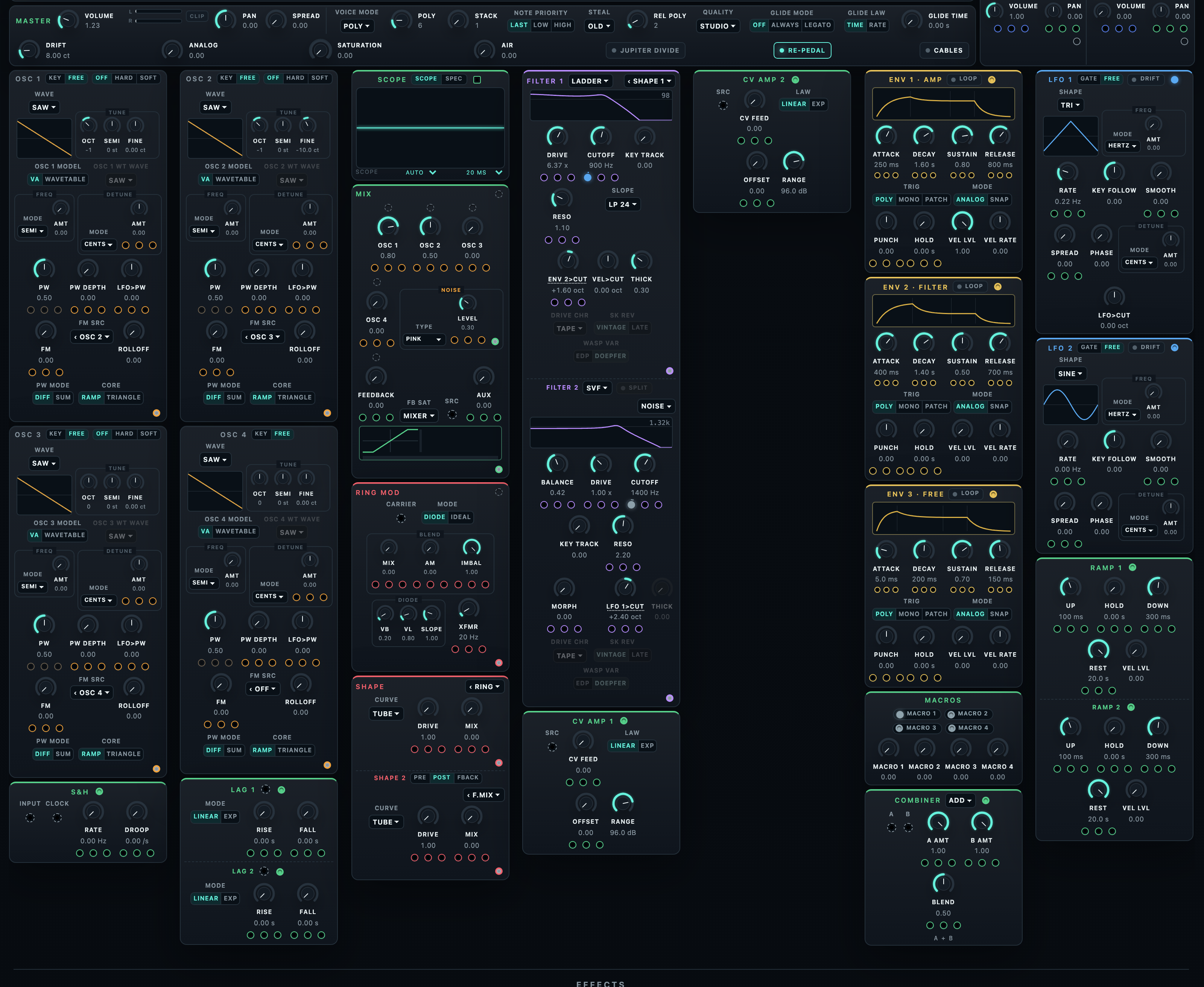
Luxium brings analog-style movement, flexible audio routing, expressive performance controls, and a complete effects rig into one instrument. Explore the design choices behind its sound and feel.
Each of the four oscillators in every voice follows its own tuning drift, alongside a shared per-voice layer. Play a four-note chord and those oscillator paths can move independently rather than following one curve.
02
14 authentic filter topologies
Dual slots host 14 genuine circuit models—Moog transistor ladder, EMS diode, Oberheim SVF, Korg MS-20 Sallen-Key, Steiner-Parker, EDP Wasp CMOS, Roland IR3109 cascade, and Buchla 292 lowpass gate. Series, parallel, or split, with zero-delay feedback and low-end retention.
03
Selectable render quality
Choose Eco, Studio Lite, Studio, Master Lite, or Master to balance processing cost and sound quality. The voice rate follows the host rate and selected tier; in a 48 kHz session, Studio runs the voice graph at 96 kHz. Local antialiasing and solver settings adapt to the chosen quality level.
04
Stacked dual-layer tuning
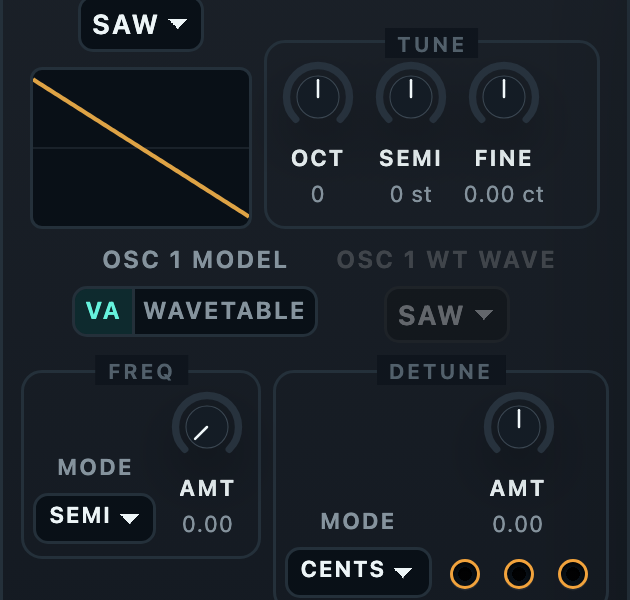
Every oscillator and LFO features two stacked tuning engines: SEMI, PARTIAL (exact harmonic locking), SUBHRM, HERTZ, and SYNC, composed with CENTS, HZ5 (constant beat rate across keys), BEATS (tempo-locked pulse), and MTPLY (multiplier or phase-frozen waveshaper).
Physical circuitry at the core
Imperfections modeled where they actually happen.
Rather than slapping a generic saturation plugin onto the output, Luxium models the physical failure modes of real hardware right at their circuit nodes. From mutual injection locking to component aging, every control alters the actual physics of the voice.
The result is an instrument that responds dynamically under your fingers—moving from immaculate laboratory precision to raw, starved, and gloriously unstable analog character.
Oscillator tuning · stacked frequency and modifier modes
Mutual injection locking (Pull)
Closely tuned oscillators physically pull on each other's resonant cores. Sweep the Fine knob across the boundary and hear the two waveforms fight, slip, and snap into sudden, authoritative unison.
Voltage starvation & capacitor age
Starve lowers the simulated power rail—simultaneously dropping pitch, slowing envelopes, and dulling filters. Cap models failing dielectric in coupling capacitors, subtly flattening upper registers as real vintage gear does.
Body contact mains hum
Touch the simulated circuit board with your finger. Contact injects 50 Hz mains hum directly into the oscillator clock, filter bias, or VCA, normalled to aftertouch and MPE pressure for organic, physical expression.
Playability & voice allocation
Engineered for musical performance.
Luxium solves the classic frustrations of analog polysynths while introducing expressive performance tools built for players.
Jupiter Divide
Play a single note and it receives the full unison stack. Play a chord and Luxium dynamically and evenly redistributes the voice pool across held keys, keeping leads fat and chords balanced with no manual switching.
Singing voice stealing
When voices are stolen during dense polyphonic passages, incoming notes inherit the existing envelope level rather than retriggering from zero. Fast arpeggios and chord transitions stay fluid with zero clicks or pop artifacts.
Re-Pedal guitar restrikes
Hold the sustain pedal down and restrike chords the way a guitarist strums. Fresh strikes damp the previous ring before allocating, preventing muddy build-up through driven amps while held keys continue sustaining.
Studio rig & LushVerb built in
A 10-slot reorderable chain with 10 amplifier circuits, 10 physical cabinets with continuous 3D mic placement, and the full 10-algorithm LushVerb acoustic engine means your sound is finished inside the plugin.
Modular freedom
195 modulation destinations & audio patching.
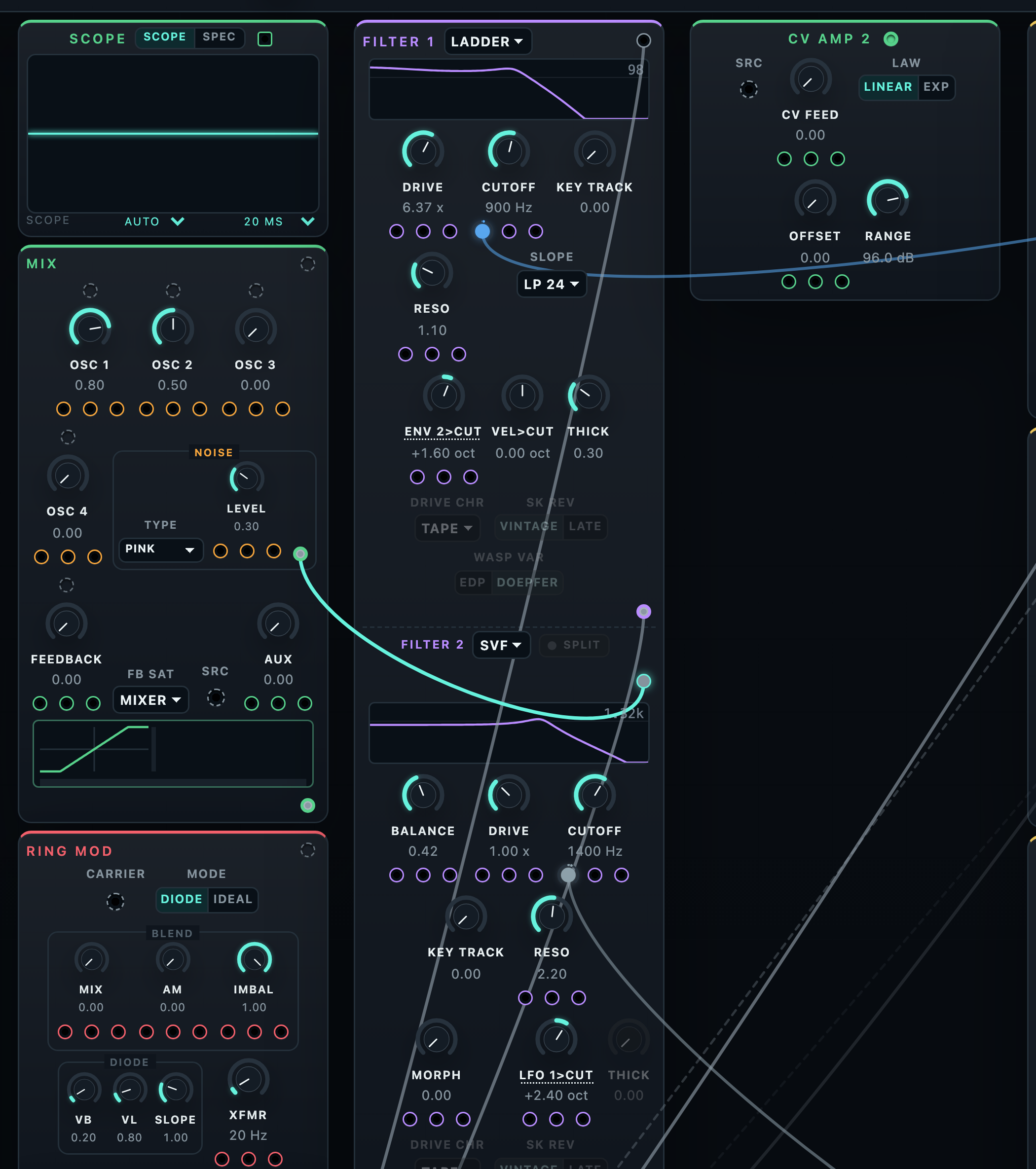
Voice page · audio cables and attenuverter rings in action
64 summing modulation routes
Every knob wears an attenuverter ring. Drag cables directly onto knobs or right-click to connect. Routes sum with signed bipolar depth and animate live with modulation rings.
Audio-rate module sources
Oscillators, filters, shapers, and noise can serve as audio-rate modulation sources. Route an oscillator into cutoff for filter FM, or into pulse width for audio-rate PWM.
MPE & MTS-ESP microtuning
Per-note pitch bend, pressure, and timbre (CC74) integrate with MPE controllers. Luxium follows an MTS-ESP master’s tuning through one shared tuning table for the instrument; separate per-channel MTS tunings are not supported.
Stay connected
Follow Luxium’s sound design and release updates.
Subscribe to our newsletter for synth patch recipes, sound design walkthroughs, and audio demos, or sign up for news about Luxium releases and beta builds.
This early offer is for musicians who want to explore Luxium, report what they find, and help shape the workflow, sound, and capabilities of v1. The price will rise as Luxium matures, and we cannot guarantee how long the current promotion will remain available.
Stay in the loop
Choose the Luxium emails you want.
Release alerts and Uniphonic news are separate. Pick either one or both, and change your choice at any time.