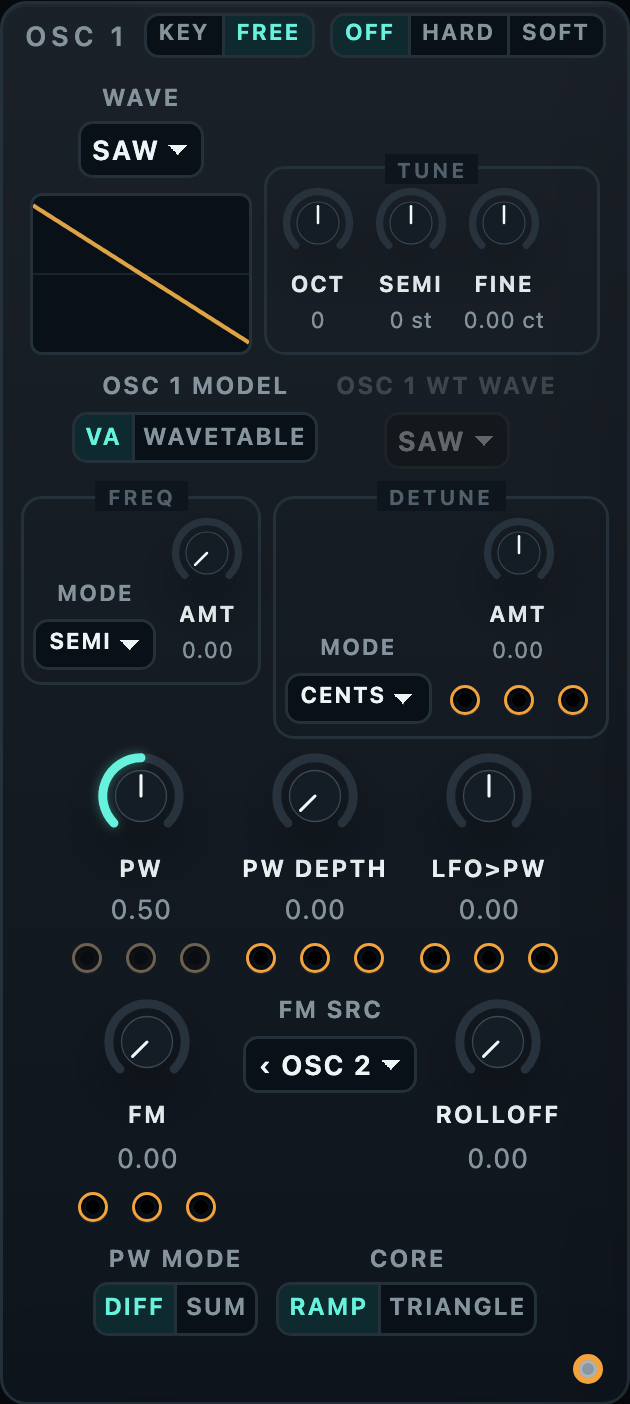
Four oscillators, four lives
Every oscillator can run its own waveform, tuning, through-zero FM, sync, pulse shaping, and continuously moving drift path.


A boutique semi-modular synthesizer with four oscillators, component-level analog behavior, deep cable routing, and a complete studio and guitar effects chain.
Audio Unit + VST3 · macOS 14+ · Windows 11 x64
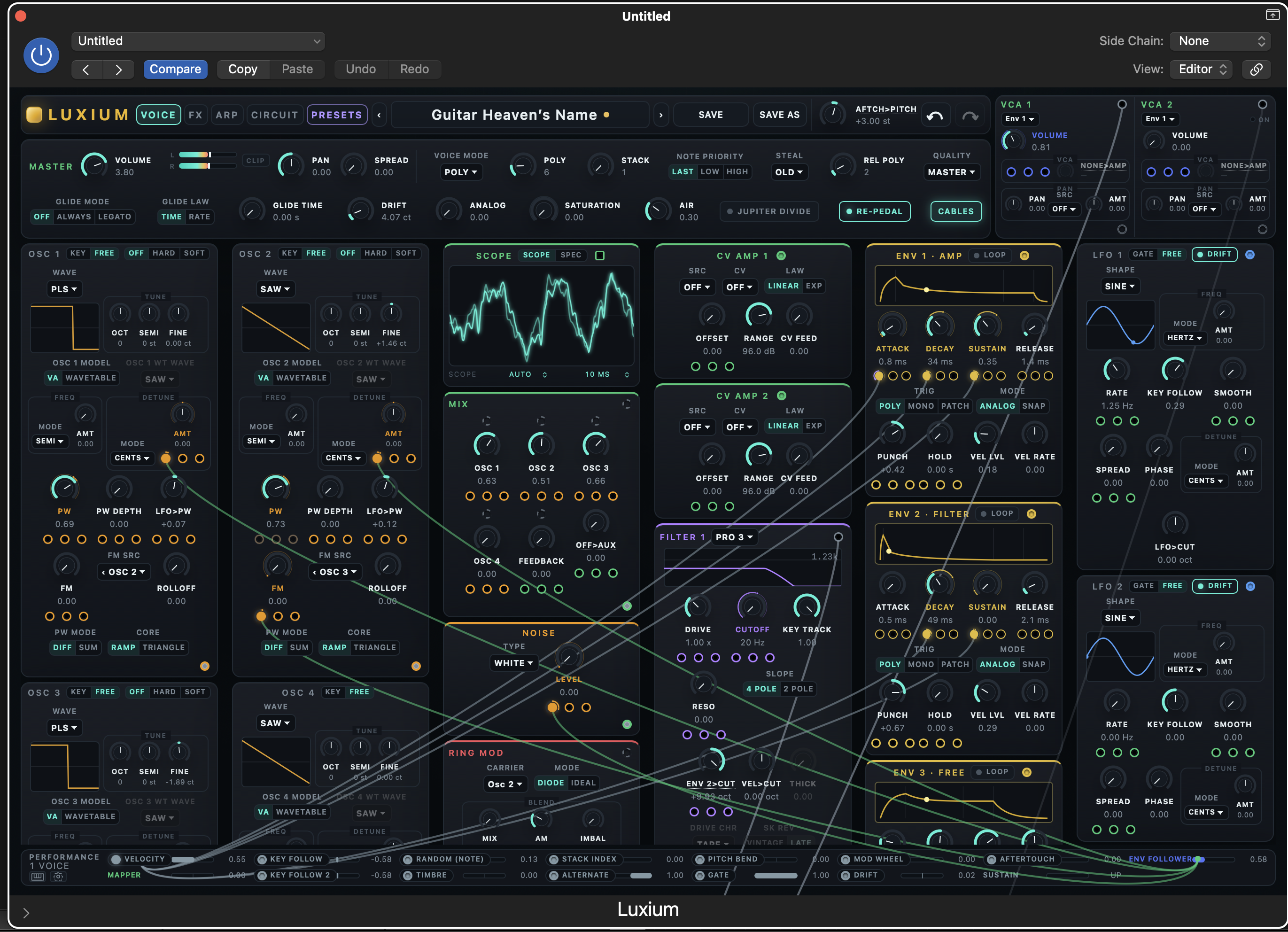
Every oscillator can run its own waveform, tuning, through-zero FM, sync, pulse shaping, and continuously moving drift path.
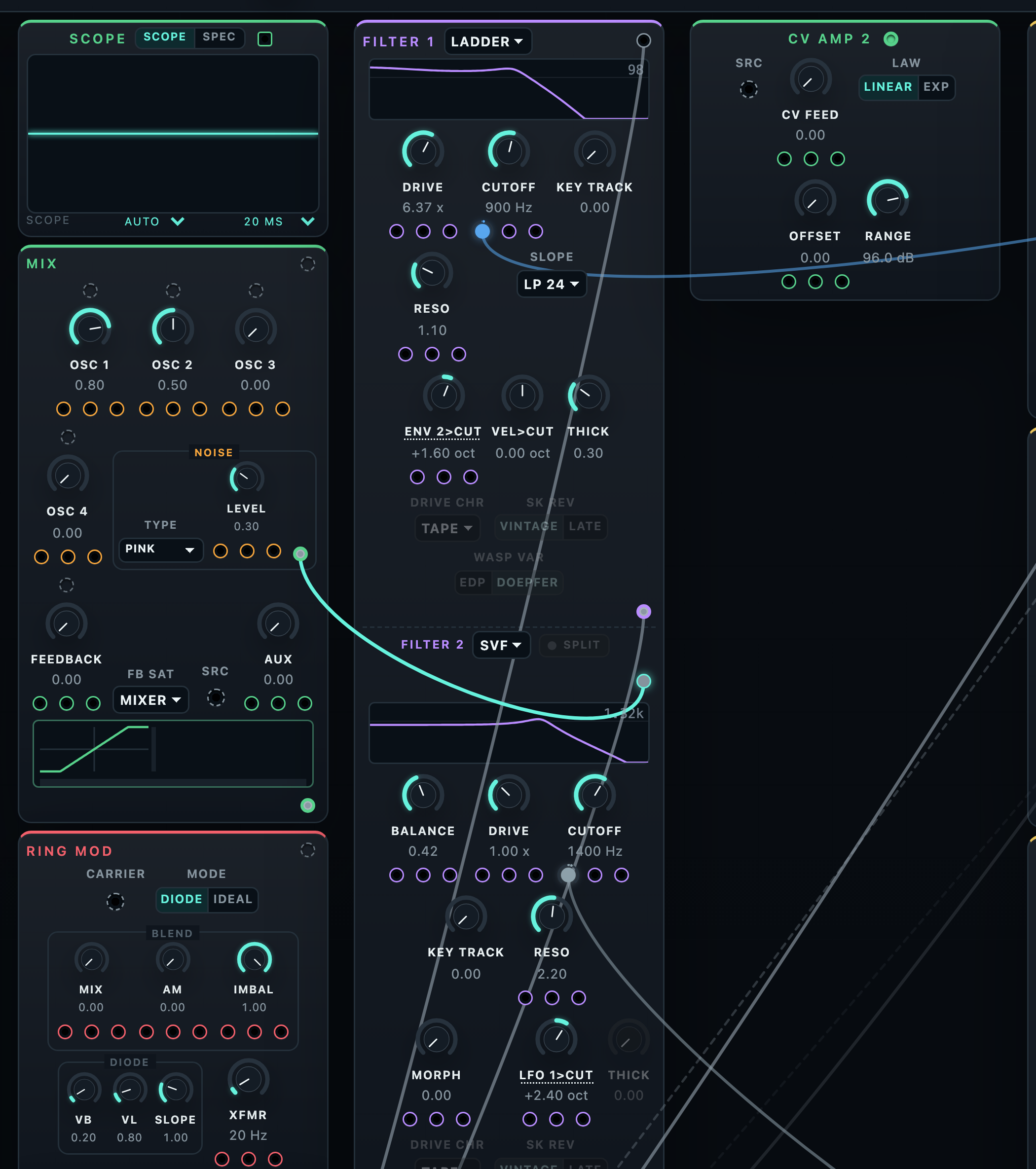
Replace normalled audio connections, cable module outputs into modulation destinations, and reshape the signal path while notes are sounding.
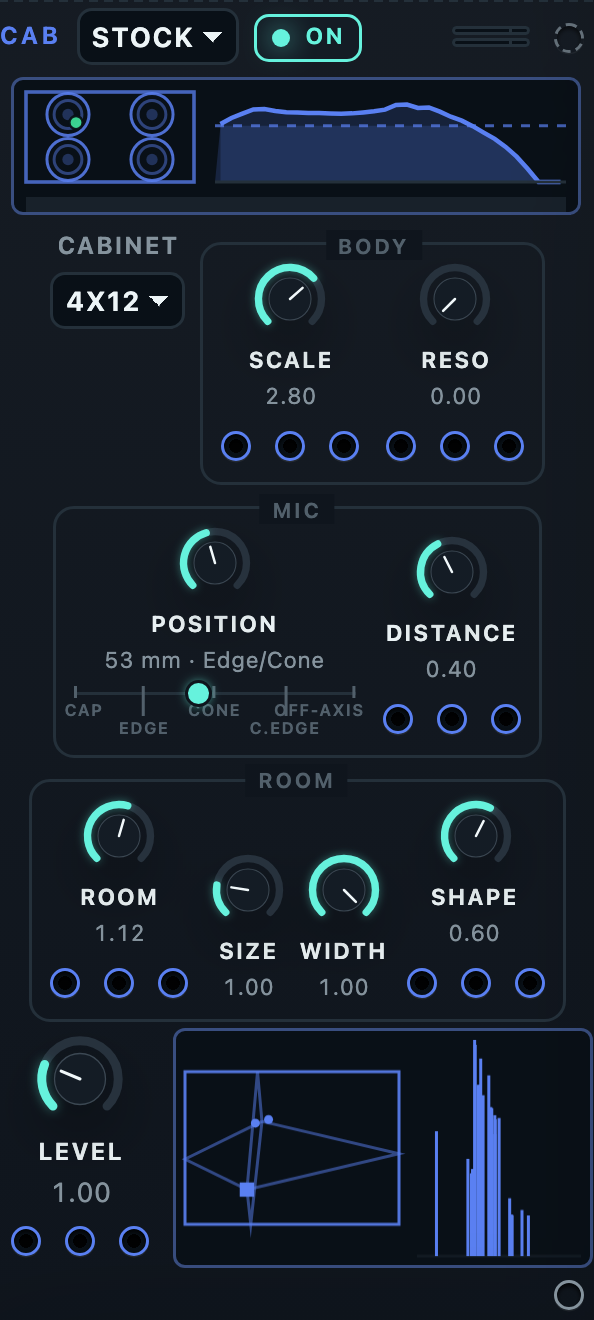
Move from synthesis into modeled amplifiers, physically responsive cabinets, continuous microphone placement, and LushVerb without leaving the instrument.
Per-voice component tolerance and per-oscillator continuous drift create variation within a note, across a chord, and over a performance.
The normalled signal path plays immediately. Patch cables can then replace audio connections, create parallel paths, and turn module outputs into modulation.
Modeled amplifier circuits, continuous mic geometry, physically scaled cabinets, and a reorderable effects chain make external audio part of the instrument.
LushVerb brings ten algorithms, shimmer, chorus motion, randomness, ducking, freeze, and a rich moving tail to every Luxium voice.
It did not exist, so I built it.
I wanted an analog-style synthesizer that behaved like the classic polysynths: real voice stealing, where a stolen voice hands its envelope level to the incoming note, the behavior some instruments call singing envelopes. I wanted it to play like a guitar too. A guitar string re-triggers the same note without stacking on top of itself, so you can hold a chord with the sustain pedal and strike it again and again through a distorted amp and the notes never pile up. I wrote custom scripts around other synthesizers, including Reason’s Thor, to approximate that, and none of them gave me the behavior I was after. In Luxium it is a switch called Re-Pedal.
I also wanted the modular side. Audio cables plugged into modulation inputs. Filters and effects I could swap and wire in different orders. Module inputs I could overdrive, so that pushing a filter or a shaper past clean gives rich harmonics and a real edge. And I wanted a proper guitar effects chain in the same instrument, with distortion that sounds good.
No product combined those things. Some had two of them; none had all of them together. After years of searching and wishing, I decided to build it myself, because I am a software engineer and that was the one thing I could do about it. Luxium is that instrument.
Jacob · Uniphonic
Four oscillators, per-oscillator drift, component behavior, 64 modulation routes, audio patching, filters, envelopes, and Jupiter Divide.
Explore the instrument →02Ten modeled amps, ten physical cabinets, continuous mic placement, real-time cabinet scaling, and the complete LushVerb engine.
Explore the effects →03Get a perpetual Luxium v1 license, every 1.x update, offline activation, and a chance to help shape the final release.
See pricing →This early offer is for musicians who want to explore Luxium, report what they find, and help shape the workflow, sound, and capabilities of v1. The price will rise as Luxium matures, and we cannot guarantee how long the current promotion will remain available.